Monday, January 19, 2009

Two Airplane Events
It was a cool clear morning, we all remember - we all have been remem-bering for almost eight years. And I am not trying to desecrate or rhapsodize; I do not use these images to sensationalize. 

We followed its path that morning in our many different stations, the small plane became a jet.  The first jet was followed by a second. We stood riveted, what do we do? And in those horrible moments after the explosions we all lost something - the futility of the situation, bigger than life and yet putting so much life at stake. The despair coming from seeing the tragedy and being able to do nothing. And then those gut wrenching moments when one and then the other of the buildings pancaked into the ground leaving a void larger than the space they once filled. We all lost something that day, everyone one of us. Two airplanes taken from their pilots and turned into bombs. Two airplanes flying low across the city; how many New Yorkers gazed up to see one pass that morning or heard the strange buzz of engines too low to the ground and knew that something was amiss somewhere? They froze us in place. Watching. Unbelieving. Being acted upon.

And then, how many New Yorkers stood in place watching again last week as an airplane taken from its pilot, glided silent and low over the streets of New York, and into the Hudson River. As if a coda on the end of a trying and difficult era, in the days before we celebrate Martin Luther King and welcome into office Barack Obama, the most unlikely of Presidential candidates, the water landing of an Airbus in the Hudson River has given us new metaphors and useful tropes.  The airplane, taken from the pilot by the random presence of Canadian geese, inexplicably turned into a boat once it touched down in the river.  Our metaphors have been so dreary since that September day.  Now we have something new, something unmistakably transformative.  Experience and training, quick thinking under fire,
saving lives. We have photographs of people waiting to climb to safety.  Images of tragedy averted, of help arriving.  We have learned of the fear when the knowledge of a crash became clear in the airplane, and the panic that arose when the plane came to a stop.  We learned that people took care of each other.   We have images of perfect strangers holding each other on the slippery edges of wings that are sinking below icy water.  We see boats and companies with no fiduciary interest in this aircraft or these people rushing as fast as they can to the problem.  Let us help out, they said.  It was a moment of great humanity in all senses of the word.  It was the second airplane event, the other shoe falling, a tragic set of circumstances accompanied by a different set of human values, a fundamentally alternate outcome, the dawn of a new era. I know those who found themselves weeping as they watched the passengers get ferried safely to shore, as they read the stories of near death, the shouting in the cabin, the visceral fear as water streamed in around windows, I know they felt the same pent up sorrow that I felt; relief.   The recent past, these last eight years, were made all the more unnerving in contrast to the genuine compassion expressed that day.  

Such moments in their authenticity have a strong residue; in its historic and spatial placement, the saga of the water landing in New York last week concluded a drawn-out period of mourning.  The thing we had lost has returned. We can move again.  And act.

Thursday, January 08, 2009

Towering Forest of Fennel
The whole transformational quality of it.  The changes every day and slow metamorphosis over the course of years.  This forest, these evergreen giants.  These are dog fennel (Eupatorium capillifolium ).  They have grown a full season in the soils that were populated with Brazilian Pepper alone when I began my time here at Eckerd.  They have grown, leafed the fluffy wispy leaves they grow, flowered, and died.  Only the uppermost branches still remain on these plants, the others have dried and turn to dust.  It is dusty these days in the Pam Hammock as thousands of last season's dog fennel turn to dust.  At their base, next seasons stalks begin to poke up through the soil like green slippers or a pool of seedlings.  

Or a grassroots president who seems to be paying attention.

Saturday, August 16, 2008

Adaptability
This spurge whose delicate flowers erupt in tiny floresence from the stem of the parallel leaves covers ground where ground needs covering.  It is named in a dismissive manner because most would rather dismiss it.  But up close it is quite a sight to behold.  This one is spitting out flowerettes almost faster than I can photograph them.  It doesn't have the purple coloration that other varieties in the region have.  It covers abandoned lawns, a single shoot putting out a large radial plant.  It fits where there is space.  This is a rule of nature.  

We are are more conscious (or at least try to pretend to be) over here in civilization.  The conscious effort of so much rational thought.  Organized, somehow.  It is not the rules of nature over here.  These are different rules.  We like to naturalize them, but they are different.  We have the opportunity to reflect.  We think.  There is a world of difference between the following of impulses and the deliberative approach.  We presume a deliberation.  We like to think so.  That somewhere, someone is paying attention, enough attention.  We like to think so.  We reflect upon ourselves sometimes -- perhaps from faulty premises, but the effort ought to be appreciated -- and consider and deliberate.  This spurge seized the day in the mottled jungle of tropical coastal plants, it will live on.

Monday, August 04, 2008

The Something

There are so many plants living in the Palm Hammock that some of them have escaped my view. And then, one day, I happen upon a gem, a rare, unknown beauty. Many, like this one, are small flowering annuals that can live on into several seasons because of the region's mild climate. This plant does not appear in my identification manual. Nor am I enough of a botanist to track it down in a technical key. But it is a beautiful specimen. Its leaves are long and narrow, unusually sturdy for an annual species of plant. They curl up ever so slightly along their length. Five, as you see, accompany each florescence, the florescence each comprised of tiny bursts of nearly petal-less flowers with small straight pistil and stamen. The plant itself is rigid and almost awkward in form. Long stretches of stalk, insect-leg joints with a fan of almost lance-like leaves and these delightful bursts of symmetrical reproductive tissue. It needs a name. It has already evoked a meaning.

And so this anonymous plant, and so many like it, live on in that cherished plat of land saved there on the west side of campus. Its flowers will erupt for the next several weeks, rains feeding its patient roots. The same weeks in which the national charade unfolds again. Will world-changing tectonic events follow in the wake of a Democratic victory in November? Yes, and no. It will calm what have been very muddied waters and sooth what have been irritated wounds and it will return the reigns of power to the hands of people who use fact-based reasoning to make their cases. But the real changes will have to come from within, or below, or around. There are immanent reconsiderations and re-visionings waiting to be performed. You and I must do that. Here, where we live. Like this unnamed something that holds itself anonymously beautiful and decorates my restoration project on the sand heap at the eastern edge of the Gulf of Mexico, we might all find some renewed obligation to produce beauty just because.

Monday, May 26, 2008

Dogs and Sedges

This plot of land, filled with dog fennel and sedge, sprouting live oak and buttonwood, blooming gaillarda and beach sunflower. This plot of land, worked by the hands of dozens in this community, rag tag as it is. These cabbage palms, the Ludwigia (Ludwigia leptocarpa) growing new leaves out of the top of seemingly dead last year's stalk, capeweed and ground cherry, vines and grasses. This verdant land.

Eucalyptus towering in the background, the anomalous exotic, planted by some other idea before the final plans for the school took shape. These trees that have drawn the most attention this past year, housing three settlements under their branches, notched tree limbs and ridiculous rope contraptions.

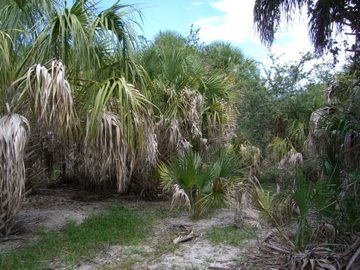
This palm hammock, where coyote and marsh rabbit roam, where hand to hand labor exhumes the twisted bodies of root mass and tangled strands of root that gave life to the carpet brush created by Brazilian pepper plants. Where clearings like this one appear where they were theorized not to have a chance.

Theories.

Tuesday, May 13, 2008

The cause

Gaillardia. Perhaps the most showy of Florida native flowers. These delightful draught tolerant flowers are known locally as 'blanket flowers.' They fill up your flower bed like a thick winter blanket. Their leaves are almost succulent. White hairs seem to reflect the sun's heat. Their very appearance is suggestive of the sun itself. A sunburst.
Gaillardia pulchella, blanket flower, frequenter of sandy spots in the vicinity of the coast. This one erupted on the sandy plain of my restoration project. It got there with my help; I tossed seeds out all fall. But it grew of its own volition, and survives of its own will. There are some who reject this
absence of purity, the hand of man, the hand of me. But when you see these colors, blooming amidst browning sedge seeds and bright green dog fennel, you cannot help but feel a small pang of joy. They seem to float above the succeeding annuals and they seem they want to stay. It hasn't rained here for two months. We need the water from the skies because we have no real soils and our top layer is porous sand. We have drained for two years. Draught. And still these flowers bloom and cover the ground in a thick blanket of leafy, stalky, plant cells. Cooling the ground, drawing water from the most remote and unlikely of earth material. The presence of adaptation. Some things, they say,
stay incessantly the same, while others shift and adjust. Which parts work together how? What ways of seeing are respected and considered? We try to integrate our own best thoughts into something altogether stylish. We wish, sometimes, that things had been easier. All of our efforts seem shamefully short sighted. But when we pause, as I think some of us have paused, when we wait for that moment and rather than force, persuasion. We find something profoundly our own, or somehow deeply everyone's. We realize that we all want to shine, each in our own way. And shine we shall. Bright orange pedal dreams, yellow tipped fantasies, alive in the air where no living thing was given much hope.
Flourishing, where only dreams had reigned.

To talk, anymore, is the worst of fates. Talking has nothing but traps. To hope for a better day, to want to inspire, seems to attract the most loathing of spite. And, yet, talk we must, and hope we do. Another season in the sacred Palm Hammock has come around and life is blooming and buzzing and howling like life wonts to do.

Saturday, October 13, 2007

Eternal Hope
This sprouting Pink purslane (Portulaca pilosa) has made its home at the edges of the sacred Hammock growing here on our campus. This place is full of life and persistence. A summer of rainfall after the long draught brought up seeds that had waited a seeming eternity for the life spark, for the holy water to switch their processes on and send roots into the well-drained soil and send cells skyward. The Portulaca loves the climate. It's succulent leaves grow fat wet cells that cherish the rain waters and hold them close even when the summer fades to fall and rainstorms come less frequently if at all. It's iron rich fiber is a tribute to its strength, delicate yet sturdy, delicious on a summer salad and delightful to observe. This sprout may be a few weeks old, if that. They branch and spread at their base as they grow, sprouting shining flowers, purple and eye-catching, tempting us to remember that life does not care if the landscape is comprised of but a heap of sand or the rich loam of the prairie, where seeds drop and rains fall and sun shines, life can be found. Where energy enough to set the cells in motion has been established, something lives. This flower will go to seed next week or the week after that and store the same knowledge and hope and it will drift outward away from the base and wait for another summer's season to roll through. The floor of the Hammock is covered with these plants. Annual ground herbs, first stage succession, the promise of life and the beginning of a long cycle of change that will one day have this earth say Oak and Palm, where it merely says purslane and crabgrass now. The plant is nothing without the ground in which to root its fibers, and nothing without the rain with which to fill its cells, and nothing without the sun with which to energize it growth, but with all of these it is its own statement and presence and beauty. A beauty that has come to have some call this species "Kiss me quick" to which my eyes have always abided. So much history in a single stalk. Eternity in a bloom.

More knowledge here than in all the planners in Washington. More foresight and trial and error. We would serve oursleves well to notice the foolish ways in which our own extracted consciousness has ridden itself into a dilemma. Power has come to stand in for intelligence, force for right, ignorance for truth. Thoreau once wrote that "just as a snowdrift is formed where there is a lull in the wind, so, one would say, where there is a lull of truth, an institution springs up." The lulls have been long and yawning. Whether change or not will come is not a question that the polls will answer. Only you.

Wednesday, May 09, 2007

Exotic Lament
This majestic eucalyptus tree (Myrtaceae eucalyptus) catches the setting sunlight in the back corner of my lot here on this heap of sand welded onto the North American continent so many eons ago. The tree sometimes seems as if it has been there since that time; its girth almost twenty feet and it towers above every other living thing in my neighborhood. Eucalyptus are not native to Florida, they evolved on the continent of Australia, and are unique to that island nation. But their beauty, the white woods exposed beneath a pealing rolling bark, the scythe-like leaves, drooping with authority, and the star-patterned flower clusters all attract themselves to the human imagination. We have dispersed it to our living places everywhere. In Southern California, where the eucalyptus finds a climate much like its home climate in Australia, the tree has become something of a nuisance, so loving the warm dry air of the region that it reproduces beyond its wildest dreams and does so with such fervor that other forms of life get pushed aside. Its seeds seem to sprout on every piece of ground they reach and they grow with such speed that one cannot blink an eye lest they become invaded by the plant. We are luckier here in Florida where the trees will do just fine but cannot take root from their own seed in the sandy ground. I do not know yet why, but I do know it is a truth. In our plam hammock on campus, there are four eucalyptus trees planted in the late 1960s who are not even close to the size of this one but who grow flowers every year and seem to drop some seed, but have not succeeded in spawning progeny. The curving scythe-like leaves are reproduced in the curving armlike branches, the tree fills space and shades yard, and sheds bark and leaves and has what can only described as a presence. I would welcome it under any circumstances and worry not one lick about its staus as an exotic, a moniker that sends shivers and tremors through the nerves of some purists I know. To be from elsewhere is a dangerous thing; to be unusual or unlike is akin to criminal behavior. Purity is desired, the true landscape, an ecology untouched by humans, unblemished by the acts of human will. I do not have to play this out very far to expose its shallow roots and wilting leaves. We do not do well to condemn that which lives and only serve to do what death does by doing so. Ideals are forged in the cauldron of imagination, which, when unstudied, comes to badly built conclusions. Know thy metaphors, and rethink thy place.

The erstwhile architect of our failed disaster in Iraq and current tenuous head of the World Bank is one whose metaphors have gone all wrong. The diminutive and gargoyle-like demon has through the force of his own ill-conceived will over these past six years led us toward more dead ends and bad situations than the King of England ever even threatened and still the sensibility of the other powers cannot quite push him from his heights. The forces of good are not at play in this nation any longer, if ever. The forces of humanity have retreated while evil men with small minds and only selfish goals feed at the public trough and steal from our best intentions. All the while, those of us who do nothing, who choose our own self interest only serve these powers. We do not live isolated lives, we merely cultivate isolated imaginations. We have been cloistered by technology and decception into our own self-defeating units of non-power, non-will. The traditional family is such a lust word for the powers that be because it forces us into units that cannot hope to contend with such power. We are no longer public or social or collective or guided by our better instincts because our better instincts are denied us in our boxes and refused us by the market, and squelched and laughed at and turned sour by experience. Paul Wolfowitz, under a reasonable government operating according to long-accepted principles of justice, would have been jailed long ago. Our president, too. Crimes are crimes and they should be punished, but we are too much distracted by our own petty lives and the stuff we think we need to fill them with. The violence perpetrated on us is generational now, it numbs us to truth and shields us from even ourselves. Antoni Gramsci called it hegemony, where the social group of capitalists, those who own and control capital in this deceptive system we have been sold, rule over the rest of us with an iron fisted reality that denies us our birthright. Go ye to your dungeons and caves, invest thyselves with nothingness and aspire to the empty status of consumptive beings. Be what you are through what you own, know who you are by what others say of you, lose yourselves in the lie, for the alternative would take more imagination than we have cultivated in this nation of ours. Live the dying lifestyle and do not ask why, you have been well trained. Do not, whatever you do, aspire to live a life as present as the majestic eucaplytus, branching to your true nature, filling out a girth worthy of titans; that would be sneered at by your neighbors and upset the Walmart stockholders. Go ye! The time is ripe for self-defeat.

Friday, April 27, 2007

Plant burst
The pepper grass (Lepidium latifolium) exploded like a green bush firework after the heavy rains that fell in early April. The plants is known as poor man's pepper for its mustard garlic tasting seeds and is said to be high in vitamin C. It is a member of the mustard family, but because of reasons lost to history, this one and its common species grows as a weed in disturbed landscapes and empty lots. Reports of its presence are found from Virginia to Florida and west to the Colorado Rockies. It can be eaten by people, but mostly isn't. Instead it propogates itself with the help of wildlife and winds, and its own strategy of producing a sunburst of seeds. This one caught the morning light in the Palm Hammock as I made my rounds one morning last week. Something about the multiple layers of leaves and flowers growing up out of the multitude of stems gave it a wonderful, light, and attractive appearance. I could not take my eyes from it and I pondered the pure beauty that it presented. These plants have grown early in the season down here on this heap of sand called Florida, this is but one of perhaps several hundred that dot the Palm Hammock right now, having begun their life during the rains of January and persistently grown on through a long draught. The pepper grasses I remember from last season, which no doubt parented this one here and the many others, were not so full and robust, but presented themselves in a taller thinner form. This one tickled my imagination, did it look like thought as it bursts in the mind? Can nature offer anything but delight? Does it remind me of the complexity of what one might call engineering lurking in the cells of every living thing, the history of persistence and tenacity, the dogged pursuit of living that spawned our own kind? Can one embrace a form with one's eyes? Can a form speak to us? This pepper grass in its spark of life gave my morning a completeness that the grandest cathedral in the world would not have achieved. We must notice these moments. Relish them. Cultivate.

How much nature and living and life was lost on the poor angry soul who took so many lives in Virginia last week. I watched with the same horror as everyone as the numbers rolled in and the facts came pouring out over every web site and news cast, the buzz began to tumble over itself like a verbal avalanche and before long it was no longer about what it was about, but about itself only and people nowhere near the events and no sense of history. I watched as television news became more concerned with its own navel and I watched American culture as its sick discompassion pretended to care, and cared not a whit. A culture without true humanity can make no sense of human frailty. Death and a massacre become cause for fake compassion, false love, pretend concern, all of which is just an expression of the true emotional confusion that comprises our collective existence. Those poor children and professors. Yes. And I wish help and healing and some means to make sense of the losses to the families. But I am ashamed at the official response. I am ashamed that it makes the authorities decide their mistake was not enough policing, not enough threats of violence. They police just fine, thank you. Too much, one might say. Violence is the only answer, so then why would a lost soul not turn to what his own authorities propose? A little more health care, a little more compassion, and a true sensitivity to the rhythms and needs of human culture is what could have avoided this tragedy. This was not one lost soul, unexplainable but as an anomaly, this was us, and our lives and our lifestyles and our selfishness and our callousness and our desire for riches and competition and lust for material coming home to roost. When all you can see are potential advantages, you take advantage. More sensitive souls are destroyed in the process. He said as much. You have destroyed me. He was not lying and even after his desperate act trying to show us something we should have seen without so much carnage, nary a person could listen; an ironic question mark at the end of a bad day, proving, in the end, that his futile desperation was well cultivated. We are not living the joyous existence made possible by the fact of living here on this planet; we are barbarians, not the murderous boy, but the culture who made him. The symptoms are everywhere, and yet we remain deaf and blind and insensitive to them. I wish for an end to these obstacles. May a new worldview explode in our imaginations, growing like the branches of a pepper grass plant after an April rain, catching the morning light, beginning your day on a true path, and aiming toward delight.

Wednesday, March 21, 2007

Life, Live
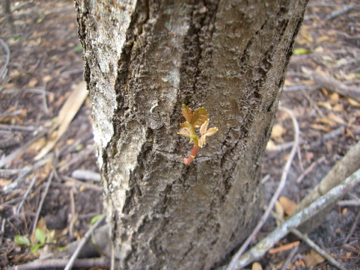
On a chosen stretch of ground in the sacred palm hammock natural area adjacent to the main campus, where we removed by hand labor a thicket of Brazilian pepper (Schinus terebinthifolius) ten years old, and were told the ground would be left barren and steril, this live oak (Quercus virginiana) has sprouted to defy the dour predictions of our nay-saying leaders. Live oak, living oak, life. The live oak does not lose its leaves in the fall like its cousins to the north. The leaves grow thick and dark green, the better to ward off the powerful rays of summer sun, thick almost succulent, rounded rather than the usual lobed oak shape, and curved slightly under, to protect the lighter colored underside from harsh reflected light. They only lose the last generation, a browning tumbling mass, when the new one is in place, in mid-March. Mature, the live oak towers and spreads across an expanse of space the size of a small home. Its arm-like branches, thick as an iron-worker's bicep, its spreading trunk, cupped almost like a human hand. The live oak, when allowed to grow into maturity, creates a welcoming space, a place reminscent of our deepest pastoral dreams, peaceful, shaded, cool, open. But that is future. Today, these three leaves represent hope. Other eyes, perhaps, would not even have noticed their presence, or perhaps would have confused them with some other plant, or trammeled this sprout with their eyes cast horizontal, not even knowing what marvelous miracle had just fallen crushed under their feet. When I noticed this sprout last week, I was moved almost to tears, overjoyed at the fact that this little piece of earth would say oak, where I had labored to open it up several months before. We are taught in these modernist days to ignore all the signs and only watch the bottom line, to treat each phenomenon as randomly unconnected to the others, to ignore superstition and laugh at belief and only trust in that which can be measured. We are lost these days, unable to notice the joy that a sprouting oak represents. This great conspiracy of ignorance, casting itself as cold hard reason, denies us our birth right and removes us from knowing the real things to be known. Our lives do matter, every step makes a difference, our purpose here is to live a life as life was made to be lived. This oak promises me the hope that such a path is a righteous one. It promises that the future is brighter than the present, that we can wish for better days and work toward them steadily. This little oak, this expression of earth and air and water and soil and seed, has proven something that all of the science in the world will never disprove. This oak is the earth saying thank you, and I will nurture its growth to say, you are quite welcome.

And still the charade unfolds in our nation's capitol; lying men and only half-lying opponents battle out a future that none of us would choose. Who among us has sent young people to their death? Who among us would manufacture weapons designed to tear through flesh with an efficieny that defines evil? Who among us has cultivated hate and distrust and an unwillingness to see all life as worthy of living? Who perpetuates the hierarchy or believes in leadership as necessary? Who profits from the death of others, and robs and cheats and steals so that their barricades can be built higher and their walls made thicker and their world more insular? What has happened to the great project of humanity? Why have we conceded to the forces of death? What is this wish for instability and violence other than a last gasp by desperate men whose time has finally come? The wise words of Henry Thoreau are useful to us now in these dark days of ongoing deception. We must not fight the market and its lying minions, we must transcend it. "Cultivate poverty like a garden herb. Do not trouble yourself much to get new things, whether clothes or friends. Turn the old; return to them. Thing do not change; we change." And so pursue that sprouting oak, find the earth again telling you what is right and true and why there is hope for the future after all. Do not concede another inch. Sprout in the soils they have told you are poisoned and flourish for the sake of us all.

Saturday, February 24, 2007

Ground cover
This beautiful yellow flower, the bloom of the narrow leafed ground cherry (Physalis angustifolia), is not usually viewed from an angle that reveals the delicate purple interior. It hangs down to the ground, like a bell, hiding its pistil and stamen from larger creatures like ourselves. But its bloom must be found, for it spreads with a steady patience across the edge zone between trimmed landscape and wild hammock, amongst other weedy grasses and invasive herbs. It appears from above to have built a flower too big for its stalk, but its success does not indicate that there is any mistake here, that cells should have been smaller in one place and larger in another. One pauses and takes the delicate bloom in their hand and gently turns it skyward and sees the patterns made inside, some code for ground ants or flying insects, who seem to always find the stopping point and fertilize the plant. This angle from the ground itself, the view from an ant plain, as it were, reveals the inside of this bloom and behind it the chinese lantern-like pod that accrues when the flower has been pollinated, waiting patiently with seed protected inside its own weather balloon. When this annual stalk falls to the ground, or extends it stalk long enough to pull itself over, a new generation will be planted. It is called a rhizome, but I suspect that the structure of its body and seed pods only make it appear as such. That the new sprouting apparent at its joints are not roots from the same, but the result of these delicate seed pods' natural reaction to the self planting taking place. This is the season of ground cherry blooming, the first of the year, to be followed by another mid-fall - the season of beauty facing downward and life sprouting up. Their charming attactive appearance bothers no one, and so they do not get classified as weeds, though they are most definitely a disturbed land species. They are out in abundance this week.

And I think back to the way in which war and violence and power and lies are tossed about and reinforced and played like an old victrola upon our otherwise sensitive consciousness. Our abstract world, our abstracted selves, not really living, barely even thinking any more. These electronic codes, having nothing at all to do with the ant plain or the smell of the air outside today or the movement of our bowels or the rhythm of what is called life. We embrace the images of lies, the stylistic falsity of reflective self-congratulation. We do not want to want to be enamoured of these constructions and yet we are, persistently. You there, reading this here, these words, a stream out of this consciousness sitting next to a device whose presence seems remarkable and yet has caused even more abstraction, and thus is not leaving a mark at all. The written word is the choicest of relics, but the means that you get to it counts. A flat screen lit from behind has all the ethical qualities of murder, in fact. Or maybe, manslaughter, for your intentions are not evil, and your goals are not bad, it is merely the outcomes. But, and I plead for attention to this point, those outcomes can only result from your own practiced inattention. Inattention to the place where you are, always. Inattention to the subtle connection, the human labor and suffering and the life trying to be lived out just past the margin of your awareness. Let today be an awake day. Let our murderous past be a lesson. Let our own conscience and not our ego and not our greed and not the shallow toss-away reasoning of the abstract market society, our own conscience, our best guide. Do listen. It knows. It can view the world from the ant's plain and see the delicate interior and understand the higher truths that our flippant desires for nothingness force us to overlook. I pray for your strength in this pursuit. And for the salvaging of your inner life. I pray for peace, as only it can be manifest - the delicate purple patterns painted inside the narrow leafed ground cherry on a warm Saturday afternoon.

Monday, January 15, 2007

Elegant Weed
This dogfennel (Eupatorium capillifolium) sprout is only a few weeks old and it has taken on the form of a miniature white pine (Pinus strobus) as they grow at the edges of pastures in New England when they are given ample time. It came up after the late December rains and if it is not cut down by the landscaping crew it will grow to six or eight feet in height before 2007 is out. By then, its similarity to pine will be long gone. It's parent stock stands in its last stages of decline on the interior of the palm hammock next to where this sprout took hold. Last fall, the forest of full-grown dogfennel waved gently in the wind and its thin leaves gave a soft fluffy green appearance and a soft feel against the skin when one wandered the former access road that used to cut through the campus nature area. In late october, the light green turned more burgundy and over time pollination must have taken place because by December, the soft ends of these not quite auburn leaves released fluffy strands of seed parachutes, carrying the next generation of this annual sprouter to all corners of the palm hammock. Those fall breezes must have carried a seed right to this spot here in a bare patch of sand amongst failing exotic turf and growing vines, beneath a struggling live oak who will one day make us proud. It may have sprouted before the December rains, but not much. The fall presented most of the plant life here with a dearth of rain, a drought, a drying up under persistant and hot sunshine. But this one made it thus far and now awaits the choices of grounds crew and the timing of rain in the months ahead. Dogfennel is considered an invasive weed because it interferes with fine manicured lawns and it invades agricultural plots (it does love disturbed soil) and generally gets in the way of people trying to use the land for the purpose of generating cash. I like it for these very same reasons and for the reason that it is beautiful and persistent and in its adulthood lovely in its many phases. It holds soil in place and towers over the sandy ground, maintaining a ground-level coolness not otherwise available in the hot Florida seasons. It helps more than it hurts in most cases, sheltering cabbage palm (Sabal Palmetto) sprouts and nurturing grasses. We dislike it because we are mistaken.

But, then, we are a mistaken culture. Brute force, and a blinding self-confidence, which manifest as a brutal ignorance of others, has come to define the essence of who we are anymore. We wave our flags and cheer as the dictators are savagely needlessly hung, self-assured about the justice of this. And then the numbers become public. We have overseen the deaths of 36,000 Iraqi's during the past bloody year of warfare in Iraq. Another 36,000 maimed and injured to carry with them for their lives, if such are possible in the territory we have ruined these past four years. We fight wars against lovely, soft hearted, delicate plants like the dogfennel and lovely kind hearted people like the Iraqis because our wallets and our bank accounts and all the things we think are measurements of our worth, must be protected and defended and bolstered and grown. We have made murder stand in for virtue, violence for progress, and hate for compassion. Not wealth at all, but that other thing, more wretched, more shameful. Turn your eyes one half turn and you will see. This is not what we want, this is not what we want to be, these are no longer our leaders, this is no longer a viable path for a sustainable future. If this is wealth, I beg for poverty. To steal from Thoreau again, "Give me the poverty that knows true wealth." Enough of this foolishness.

Sunday, December 31, 2006

Cover
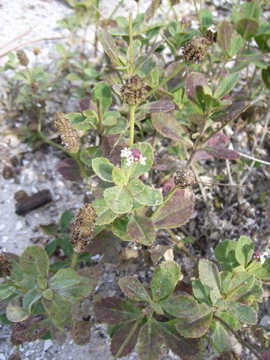
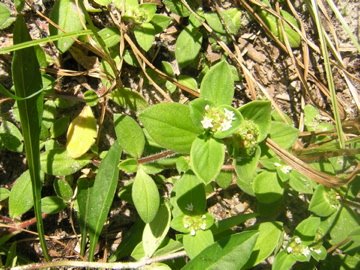
I would dare you to discover a square meter of disturbed, unmanaged land in Florida (or across the south) not covered in a layer of turkey tangle fogfruit, a.k.a. capeweed (Phyla nodiflora). I feel it crunch under my feet whenever I pass a particular stretch of lawn where exotic grasses have given way to this persistent ground herb - neglect, the retreat of herbicides, something different happened here - and I can hear when other people walk through fogfruit patches as well. It is not a succulent, but it is thick-skinned. The USDA claims it to be fire and draught resistent, and I have no reason not to believe them. It is strong and fast, as a plant; I have seen it climb a 50 foot mountain of fill and present a stable ground cover faster than erosion could do its dirty work and wear the pile down. It acts as a pioneer species in places where land has been moved, turned over, dumped, removed, or otherwise (mis)handled. I know purists who call it "worthless." It is not necessarily a native, although it lives from Florida to California across a southern band of North America. It lives there doing this work, being uneventful and unnoticed, unheralded where not altogether spited. Pulled up, its rhyzomy ivy-like structure reveals a matte, showing the whole ground in one interconnected weave of slightly hairy stalks. Each plant produces these delightful little bursts of flower, delicate white petals barely hanging on to a bulbous flower head, thick leaves, purplish-red and dark green. Ubiquitous where we inhabit the south; you may step on one today if you live here. The fogfruit is always ready to put down root, lurking and waiting for our next move. Benignly covering and protecting our sandy soil poured upon intermittently by torrents of desalinized ocean water, water purified by the atmosphere and dumped in buckets. The fogfruit grows, in part, so we do not have to worry; it holds back the true consequences of our actions. And, still, we curse its presence in our lawns and do not even bother to learn its delightfully melodious name as our soles crunch against its persistence and our sprays strangle another tangled patch to death.

In this, we are merely blinded, not bloodthirsty. We have simply neglected something; the fogfruit will forgive us easily and go on with its work. It is more a loss of delight than the destruction of something vital. Which, if only had been the case in other matters, may not have left me so deeply sullen this last day of 2006, this fourth year of this arrogant and thoughtless war, this second day of murder on the front page, this shameful, shameful fall from humanity. I do not care how angry this may make you; the hanging of Saddam Hussein was a bloodthirsty act and we should be ashamed to have been a part. Nothing of value is served by the spectacle, no one is saved, nothing is ended, vengance is perpetrated and the near certainty of savage warfare into the forseeable future is cast. It was wrong. It was foolish. More, it was evil. We did not neglect an experience benignly, or blindly in this bloodthirsty act. We let our instinct exceed our reason, we killed in full view of the television and for two days now we trot out these images as if they serve to symbolize anything but the bloodthirstiness of anger. Where is our sense, where is our reason, where is our humanity? Who have we become that we openly sanction murder, that we celebrate it in headlines and torrid descriptions of the death ceremony? I am ashamed for the United States, for my country of birth, for this great experiment in human self-rule that seems to be proving that power without education, capital without humanity, aristocracy without obligation, has no right to call itself civilized. The Bushes exposed this dirtly little secret about United States power; they cultivated it as an artform and shamed us all. And, so I wish for a fogfruit of humanity in 2007. I pray to the universe for all of us to notice how we too form an interlaced matte holding the fragile sands of power in place. They would have us forget, distract us with howls of vengance, tickle our worst emotions. In the year ahead, may we remember.

Friday, December 15, 2006

Tenacious
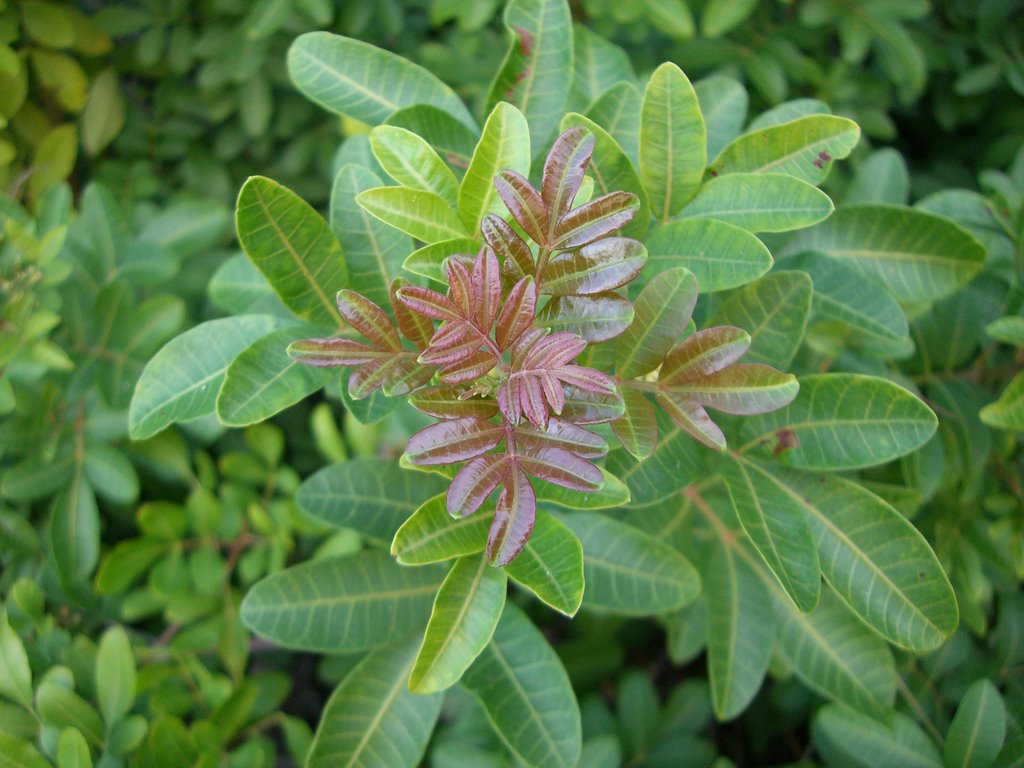
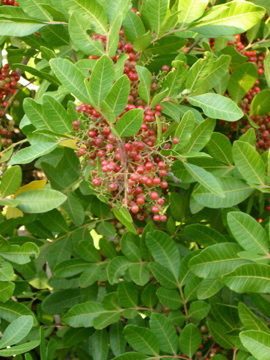
This lovely maroon leaf, sprouting and growing now, in late December, a week before winter's solstice, has a long history here in Florida. Florida holly, Christmas plant, Brazilian pepperweed, (Schinus terebinthifolius), has a history, rather than an ecology. It came late to this state, in the 1800s from South America, from the birthplace of my soulmate, from Argentina. An entrepreneurial chap in Bradenton, Florida, just south of here, decided it would make a nice holiday plant; its bright red berries and dark green leaves fruited just at Christmastime; it had the appearance of the season. And so it spread, hand to hand, beak to soil. Today, if my observations do not fail me, it is replanted daily by ravenous masked rodents. They bite off a mouthful of berries and release them complete with fertilizer some few hours later. Some time in the 1960s it reached what might be called a critical mass down here on this peninsula, this heap of sand, this Florida; it invaded every piece of farm field left to the state and to the nation during the land conservation craze of those years. And since then, it has perplexed land managers and nature lovers alike. It is unique in its qualities. It grows almost constantly throughout the year, except late fall to early winter. It can sprout from its stump, and do so with a wild explosion of branches making a cut stump a worse enemy than an old tree. And it produces, as it was brought here to do, an enormous load of colorful fruit every year at Christmastime, feeding our wintering bird population and hungry racoons and setting about an annual cycle of cultivation. It grows faster than anything around it and has an incredible plasticity of form, allowing it to overtop any reasonably sized canopy and shoot through the top. It has been classified, and rightly so in this instance for mostly the right reason, as an "invasive" plant. It dominates the plant communities where it grows, shading out everything but the dogged cabbage palm (Sabal palmetto) and an occassional intrepid live oak. It is beautiful, a plant with charm and attractiveness to the eye, but a plant with no sense of equity or fairness. It does not understand the need for cooperation, it overproduces fiber and berry and pushes itself out into every available nook and cranny and extends it arms in every possible direction. It holds a good sized bird population during daytime in its shaded understory, and armoured beetles in its roots and leaf layers. But it recreates what can only be called a sickly pale substitute for the possible variety and variation in a plant community like our palm hammock. It does not share and it does not care to. There is more to say on this matter, but for now rest it at this: I have been waging a quiet battle against this tenacious species. Its spirit and tendencies are not good metaphors, they do not teach our children well, and so we work to limit its influence. It is us, no question. It is our hands, our motives, our ceaseless desire to have whatever our impulses make us think we want; and so the work against it is hard work, endless work for a lonely soul. Work that requires patience and care and work that will draw us out of a failed paradigm. I believe that this is what Schinus can ultimately bequeath us, if we give it the right attention.

Wednesday, November 29, 2006

Fall Colors
Even here near the broad middle bulge of this planet where heat stays longer and cold hardly shows its face, the colors of changing leaves appear. This scarlet explosion is the familiar Virginia creeper (Parthenocissus quinquefolia) that grew in the Northeast, that grows in the mid-Atlantic, and that lives down here in Florida, too. Its presence on the land is a familiar comfort, like an old friend or a favorite passage in a book. Here it overtops a Florida privet (Dodonaea viscosa) beside a small vernal sinkhole at the edge of the recovering hammock on campus. It covers several cabbage palmettos on the northern edge of the hammock and elsewhere on campus. In all of those places, it has turned the same shocking scarlet. It carries the memories of colder falls in its leaf structure, deciduous. It protects itself against the possibility of frozen ice crystals, piles of snow, by drawing down the vital sugars into its roots, setting a bud, and closing down for the season. In this warm November air, it seems an unnecessary caution, but life changes slow like that, never releasing qualities that might again be useful simply because they are not presently used. It is not all competition; it is not all blood and claw, there is no fixed efficiency in the mechanical sense of the word out there in the wild (or in here in the wild, either), life persists and carries what it carries for its own sake. Who could deny with certainty, for example, that the Virginia creeper changes it's colors because that is what it likes to do? Who would insist that every quality make sense in a teleological narrative of that sort, that nothing is left to chance or accident or, shudder to think it, simple desire to live what is, in fact, life?

Because greed has gotten the high ground in Washington, DC, we voted in a slate of Democrats who just as quickly backed away from fixing the problems they said that they despised. Do not let a day pass this next year when you do not remind them of this cause. Because, without a return to ethical policies written by honorable people representing our best intentions, we risk expulsion from the human community to which we should increasingly try to belong. It is not all about competition, it is about life. I know that it is. It is about Virginia creepers turning scarlet in the warm heat of the Florida sun, and grasses fading to next year's seeds, cycles of persistence, not fleeting at all.

Monday, October 30, 2006

Purists
In one of his most revealing passages, Ralph Waldo Emerson wrote that “nature is the vehicle of thought.” In another he wrote that “Nature always wears the colors of the soul.” In the first passage he suggests that the life, collectively, mirrors our inner lives because it is the raw material for ideas and meaning; we cannot have a stormy thought without the actual storm. In the second he suggests that we bring a lot of our own moods and pre-conceived ideas to our interactions with the life, collectively. His challenge to us in Nature is to have the Discipline to distinguish these poles of meaning.

Aldo Leopold, like Charles Darwin, severed the human imagination from questions of nature. There is no vital interaction on this level; this is the veil of the modernist sciences, I think. For Aldo, the natural world was simply material that could be and had been “forged” into civilization; or a location where we must go, by foot or pack train, in order to renew our humanity and democratic spirit. The “land mechanism” was finished before we got there. Wilderness (the perfect, the finished “land mechanism”) could only shrink. We had trammeled the Garden, and once trammeled, no possibility for redemption. Leopold followed his metaphor too far, I think; we should be cautious not to do the same. When you take a cog and a wheel out of a machine, it is no longer a machine; it is only a hunk of metal (in a way, it becomes nature again). But when you take a cog or a wheel out of an ecosystem (by which we can understand Leopold to mean the removal of an entire species; his life example was wolves) it is changed, but it does not cease to be an ecosystem. This is a fundamental confusion that seems always to follow Leopold¹s wilderness logic. These ideas have spawned a kind of environmentalist Taliban, the evangelical fundamentalist naturist, extremists who, in their zeal to prove their faith, work to deny us our full birthright, “the great apparition that shines so peacefully around us.”

Historically speaking, concern about invasive species was first articulated and first noticed by George Perkins Marsh in Man and Nature (1863). It grew out of Marsh’s reading of Darwinism, which cast Nature as the only perfect force and exiled humans from membership. But the idea did not emerge as a broadly noticed issue until the past decade. Hmmmm....? Now it has come to function as one of our most common shorthand condemnations of a species or ecosystems. “It’s pretty, BUT it’s an invasive.” Indeed, most of my environmental studies students can actually identify more invasive species here in Florida than native ones; in other words, the natural world they know is an illegitimate one as far as they have been told. They crave the pure, they long for some other place where the Garden has not been soiled; they have been taught to have nostalgia for someplace else. Without diminishing the need to actively manage a wide variety of plant and animal species in order to maintain particular kinds of ecosystems and the natural aesthetics and trophic complexity they provide, I would like to suggest that the separation of human imagination and nature embedded in the wilderness ideal and in the fear of invasives is exactly the opposite kind of ideology than we need to solve our habitat crisis.

Saturday, October 28, 2006

Addendum
Brazilian pusley (Richardia brasiliensis) and coast sandspur grow in the four-acre wilderness on the succeeding dredge heap next to my campus here in Florida. Both of them are beautiful plants, elegant in their structure. They are ubiquitous, and so unnoticed ­ unless one of those spurs catches your ankle. They have, along with two strains of carpet grass, dog fennel, castor beans, ragweed, capeweed and Brazilian pepper, reclaimed a large pile of fill left in a barren heap behind the Chapel Pond two years ago. A slow amble through these places reveals a stunning display of diversity and resilience and tenacity. Each individual plant, a remarkable structure on its own, together, something else even more inspiring. Not Darwinian at all, no brutal competition, inter-dependence, and a gentle form of it at that. There are otherwise well-meaning nature lovers who turn up their noses at these tremendous plants. Weeds, non-natives, invasives, they spit. Yet they are all plants, valid in their living, and all of them advancing an ecosystem where human disturbance had taken one away. Thoreau was right about this, our home soil is always rich in Emersonian metaphor.

Friday, October 27, 2006

Tugging Seeds
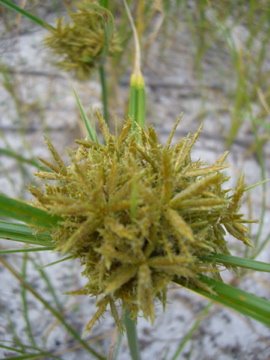
There is a wilderness of grasses and trees and anoles and large birds all living in the palm hammock at the edge of my campus, a dredge heap of invertebrate detritus less than four feet above sea level. This coast sandspur (Cenchrus incertus which means uncertain millet) is a member of this wilderness. This is a remarkable grass whose bite is as stinging as it looks. Its seeds are ensconced in hard fibrous barbed shells that hook clothing and pierce bare skin. You learn to keep an eye as you walk, you learn that this grass hides beside its less agressively built cousin, the crabgrass. You learn to watch where you step. And you still forget. Each barbed shell gets pulled from your clothing, by finger tips with skin pores just large enough for the barbs to sink themselves again, sticking to your fingers. It takes a delicate brushing of hands in the air to slight the barped pod off of you and to the ground, where you let it lie. The genius is the patience. It will wait for rain, a season of growth, the proper fertilization, and another hapless saunterer in search of vegetable game and all its progenitors will take flight again. The sandspur is a common plant along coastal areas impacted with frequent foot traffic. They follow the walker, depend upon him, rely on his careless habits and broad dispersal. Next year, a survey of the new generation of sandspur would track my studies this past Fall, retracing my footsteps of exploration as I sought new species of plant and came to know new groups of communities. The wild has multiple expressions and what amounts to a changed complexion under the steady warmth of the Florida sun.

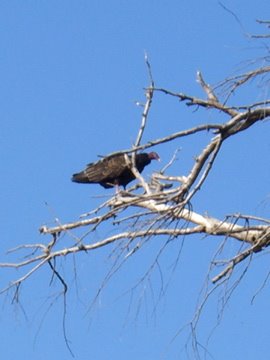
Journal: 10-23-06 -- A flock of turkey vultures (Cathartes aura) descended on the Palm Hammock today. More than a dozen. Resting, then flapping their awkward unbalanced bodies into the sky. Gliding with an uncertain wobble. Then resting some more. They have a keen sense of smell and find hidden carrion with their noses. Something must have died. They silhouette against the slightly overcast sky, silently carving figure eights through the atmosphere. They perch like hulks of feather and flesh atop the chapel and on the Eucalyptus snags. What are they scouting? What do they expect to find? They were here two weeks ago as well, although not as many, gliding through in a pack, silently seeking the dead. Craving flesh, but wishing no harm, doing no killing. The turkey vulture is a kind soul.

Sunday, September 10, 2006

Ubiquity and Infamy
My old familiar friend, crab grass (Digitaria ischaemum ), lurching out its rhyzomed stalk. I love this plant, the very symbol of natural tenacity. It is loathed by lawn fanatics world wide for its fleshy invasive habits. It crowds out the gentle stands of soft bluegrass, undermining their delicate roots at the same time. One company has estimated that 80% of all invasive grasses invading manicured lawns across the country is this very species, the smooth crab grass. You've seen it erupt from an unlikely sidewalk in mid-town Manhattan or creep out over the edge of the asphalt where standing water had soaked the day before. It sends out shoots from piles of crushed stone and will grow right in the middle of your son's summer sandbox. It only needs the slightest toehold to get started. That, and a splash of water, and a rapid unfolding, a building of cells. Acids and bases performing that magical dance that builds cells that look like cells that were built before and makes structures that look like structures of other places and other times. Crab grass (Digitaria ischaemum) is named in the first place because its pattern persists. Fantastically successful by all accounts. This one made an amazing leap from the back alley where its parent cluster spawned it before dying last year or the year before, and then it rode one of these bricks that was put in place in front of my eyes just over six weeks ago, with fresh sterile sand. I was filled with a strange sort of joy and surprise when I found it growing here this morning. The shape of the stalk, the curve of the leaf, the clumsy sprawling disposition, it reminded me of thoughts I'd had before, of things that had passed before my eyes; it's form familiar, comfortably so. You have to reach down below a crab grass plant and grasp it at the root stalk to remove it, which is near impossible to do with human fingers in a pinched space like this one between the bricks. If the root remains, more grass will grow. When the owner of this xeriscaped plot, who himself laid these bricks so many weeks ago unaware of the planting he'd done of this species, told me about how to care for the yard his rule of thumb was to "remove everything that looks like grass." I have done so with care thus far, but this one I'm leaving for now. It means too much to me.

On the anniversary of that horrible day a half decade ago the images of the lost architecture are everywhere. I consider myself blessed that I no longer watch television. But even in just reading the newspaper, there it is, again and again. And on its anniversary those uncivil bulldogs, Cheney and Rice, stand in front of cameras and recite the same lies that have been recited from the very beginning. They have figured out the psyche of the American electorate: Less than a majority is paying attention and the rest of everyone likes a good effort. That is what they keep presenting. Not the truth, not the facts, not the real world in which informed citizens live, but that they are convinced of themselves and the good effort they are making. And people seem to keep soaking it up. You can't blame a guy for trying, they say as they re-elect their doom. A good effort is being successfully presented. A false sense of order and purpose. They lie and more of our children die. The Enlightenment succeeded in producing a democractic aristocracy rooted in a free market, but it had aimed to over come aristocracy itself. This goal waits, like crab grass seed, for the right combination of water and sunlight.

Sunday, September 03, 2006

Solidago Dirge
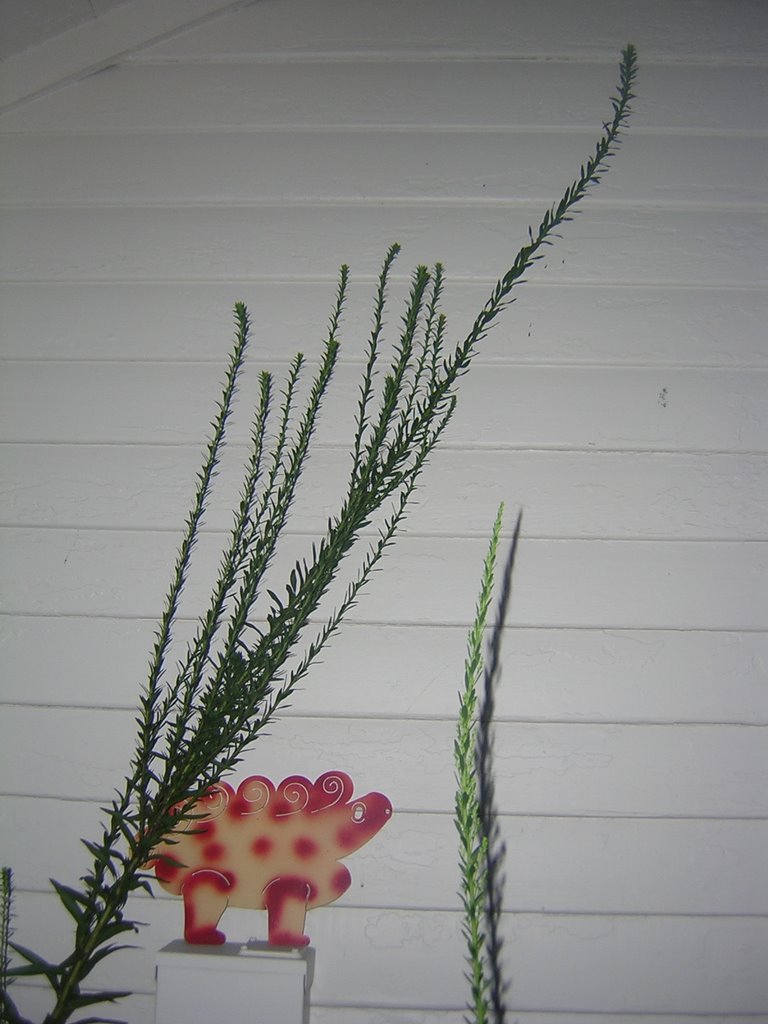
This branching towering stalk belongs to a seaside goldenrod (Solidago semperviren) planted next to the garage by the owner of this plot. There are several who have overgrown themselves, falling backwards into the garage wall or forwards onto the brick patio like drunken miners. They have evolved, as their name suggests, in seaside locations, these are dune flowers, ready to survive salty conditions and the intermittant drought. Enough water tells them to feed their roots, dig in for the long haul. More nutrients gives them a leafy stalky disposition. There is a certain intelligence in things, a place-based knowledge that serves well and adapts its knowledge to the very long term. The eruption of Asters, for example, the most recent family of plants, may be just that sort of thing. Short-term long term, variety and adaptability, patience and impatience in their proper time; seaside goldenrod, like most short lived perennials, has its species' survival in mind, if I may mix that metaphor. This one has grown leaves to feed its young roots and store up the needed energy for the certain drought that may never come in this xeriscaped yard on this pile of sand atop the piece of limestone stuck ungraciously to the underbelly of the North American continent. The water cycles daily, floating the sand enough for everything else to hold on. Keeping life in motion.

Which, as a trend, would be a good one in these days of George W. Bush. The scare tactics and violence they employ to keep the rest in order should cause everyone to shudder just a little bit. Ask oneself, of what else is he capable if these are his standards of truth? And, should we survive this travesty with parts of our democracy intact, we should be certain to think the next time. We should remember to throw a lot of money at education and food and teach civics and ethics in the classroom and make it matter as it should that someone has been born in this great nation and has the opportunities to truly make a difference. A perfect society can never be made, but if one does not work to that end one is working toward imperfection. Politics are too uncertain to be handed over to ultimatums and ideological snares, they are today's negotiations, tomorrow's hopes. The Bush's, who I am sure are a good people at heart, should be ashamed for their wayward son. This has cost too many too much. We can only hope that the ascendancy of these ideas has caused them the same sort of gravity problems that beset this goldenrod. May they tumble forward onto the brick patio of last year's mistake and leave us to grow our gardens as we will.